How do you discover your sense of belonging when your culture and background have been erased?
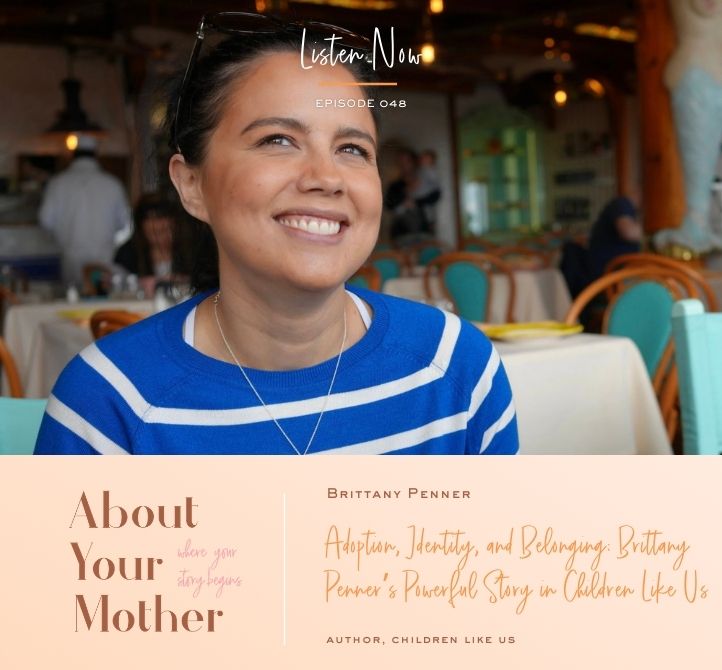
In this episode of About Your Mother, I’m joined by Brittany Penner, author of Children Like Us: A Métis Woman’s Memoir of Family, Identity and Walking Herself Home. She shares her story of being adopted as an infant, the history of Indigenous children being taken from their families in the Sixties Scoop, and her struggle with finding where she belongs.
Brittany also shares about her writing process, how writing her memoir changed her, and how she explores traumatic experiences. You’ll love this honest conversation about rediscovering your roots and integrating each part of your identity into a whole person.
Sharing Your Story Through a Memoir Versus a Novel
When Brittany first had the idea for her book, she thought it would be a novel. She wanted to write about two lineages of women, one Indigenous and another more recently settled on the land. The women’s stories would overlap through adoption, exploring themes of colonization and the harm it brought.
As she continued working on her novel idea, she realized she was trying to tell her own story. It became evident that she needed to write it as a memoir rather than a fictionalized version of the story. She had to “go there.”
The Sixties Scoop
As part of her research for her memoir, Brittany dug into the history of the Sixties Scoop in Canada. It refers to a time period that began in the 1960s and lasted until the 1990s, when Indigenous children were taken from their families, often without consent, and placed into primarily white, middle-class families.
The government claimed to protect the children, but the reality was that it was the continuation of a racist agenda, which began with residential schools, to erase Indigenous culture.
Brittany comes from a large family where adopting and fostering children is the norm. Her father is Mennonite and grew up with 12 siblings, and his parents fostered 169 children. He and his siblings continued the tradition of adopting and fostering children, and all of them were from Indigenous backgrounds, including Brittany.
When Brittany was adopted, her background was kept completely sealed. She grew up feeling like she didn’t belong in her adopted family, but she also didn’t know where she fit into society.
Growing up, everyone that Brittany met in foster care was Indigenous, and almost every Indigenous person she met had experienced foster care.
The Sixties Scoop Isn’t Over
The Sixties Scoop lasted from the 60s to the 90s, but it never actually ended. It simply transitioned into The Millennial Scoop. In Brittany’s home province of Manitoba, around 90% of children in foster care today are still indigenous.
According to a 2021 census report, around half the children in foster care in Canada are Indigenous.
By the time Brittany was adopted, the narrative had changed. It became about saving children from bad situations.
While there is a negative impact that surrounds the adoption experience in Canada, Brittany believes that her parents and grandparents adopted and fostered with good intentions.
As Brittany has unpacked her history and discovered her heritage, she has realized that it’s not a black-and-white situation. It’s filled with nuance and colorful areas. Growing up, she and her siblings never discussed the issues of feeling as if they didn’t belong. Her biggest fear was being taken away from her family, so she did her best to be the perfect daughter.
Writing About Personal Traumas and Difficult Memories
Brittany wouldn’t have been able to write her memoir if she hadn’t been through therapy beforehand. In the writing process, she took a gentle approach to herself when writing about a particularly painful memory.
She would ask herself what she needed in that moment, and oftentimes it was as simple as a 7UP or a blanket. If she didn’t feel like she could write about a particular memory at that time, she wouldn’t force it.
Brittany continues to take this gentle approach with herself when difficult memories come up. She’s learned that even though those parts of her life were difficult, they’re a vital part of her, and she doesn’t want to put them on a shelf.
Reliving and Rewriting Generational Trauma
Brittany is now a mother to a little girl, an experience that unearthed new realizations about her family’s past. When she found out she was having a girl, she was terrified about keeping her safe.
In her lineage, the last woman to give birth and keep her baby was her great-great-grandmother. She gave birth to Brittany’s great-grandmother and hid with her new baby in the bushes to prevent the government from taking her away. Her great-grandmother and grandmother both had their babies taken, and Brittany’s mother relinquished her to the government.
This made Brittany the first woman in four generations to take her baby home. Due to the generational trauma, Brittany still has a fear of governmental intrusion in her family life.
What Brittany Wishes People Understood About Indigenous People
There are two things that Brittany wants more people in Canada and the US to understand about Indigenous people:
- How inherently funny they are despite the traumas they’ve survived
- The fact that they are still here despite the attempt to erase their cultures
Does Writing a Memoir “Heal” You?
Brittany doesn’t believe that writing her memoir healed her, but she does feel more integrated now. Instead of trying to compartmentalize her life, her trauma, and her identities, she feels like she can let it all exist within her.
Her goal now is to honor the life she’s been given, her pain, and who she is.
As an adoptee, another event that you might expect to “heal” you is reconnecting with your birth family. The reality is that these reunions are often complicated and can bring up more pain. Brittany expected to feel more connected to her culture once she met her birth mother.
Unfortunately, that’s not how it happened. Her birth mother had her own complex relationship with their culture, and it continued to confuse Brittany about her sense of belonging.
In the end, through writing and exploring her personal history and that of her ancestors, Brittany has tremendous pride in her family’s ability to survive such difficult experiences. To survive is to have hope, and to have hope is to live.
Resources Mentioned
- The Sixties Scoop
- Percentage of Indigenous Children in Foster Care in Manitoba
- 2021 Canadian Census Report
- Truth and Reconciliation Day