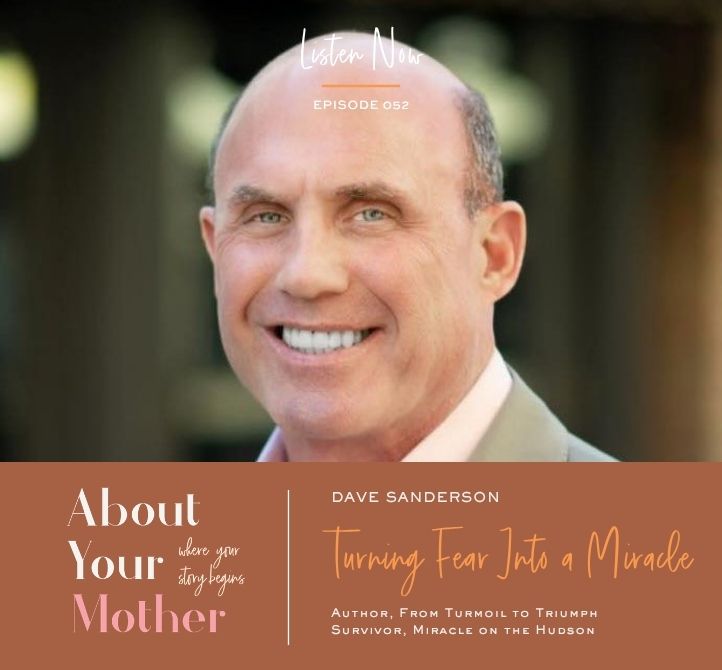
How do you turn your trauma into growth? I’m thrilled to share my conversation with Dave Sanderson, a leadership expert, motivational speaker, and one of the passengers on the flight that became the infamous Miracle on the Hudson event.
Listen in as Dave shares about his experience on the harrowing day, how his mother’s voice guided him, and how he turned a traumatic event into one of the best things to ever happen to him.
If you’re struggling with processing your own traumatic experiences, Dave’s advice will teach you how to process and reframe your emotions so you not only survive, but thrive.
Hearing His Mom’s Voice on the Hudson
On January 15, 2009, Dave was a passenger on US Airways Flight 1549, captained by Chesley “Sully” Sullenberger, that made an emergency landing on the Hudson River after a bird strike caused a double-engine failure. The event became known as the Miracle on the Hudson.
Dave’s mom, who often had to act as mom and dad while his dad traveled for work, passed away in 1997. However, that day on the Hudson, she spoke to Dave.
When the plane went down, Dave came up with a game plan. Get to the aisle and get out of the plane as soon as possible. Just as he was about to execute his plan, he heard his mom’s voice repeat something she often told him in childhood: “If you do the right thing, God will take care of you.”
Dave immediately went to the back of the plane, climbing over the seats to help others get out. He ended up being the second-to-last person off the plane, with Captain Sully last.
His experience taught him several lessons and became a milestone moment in his life. His biggest takeaway was that he wanted to spend more time with his family.
Leading People When They Need to Be Led
As a leadership expert, Dave believes that you don’t need a title to be a leader. That day on US Airways Flight 1549, he wasn’t a trained pilot, flight attendant, or aviation professional. However, he saw that people needed a leader, and he stepped up to help.
He describes the experience of landing on the Hudson as controlled chaos. Captain Sully landed the plane perfectly to ensure everyone’s safety–one degree off, and it would’ve been a different story.
People didn’t scream and panic as they do in the movies. Instead, everyone had their own game plan, just like Dave’s. As soon as they landed, the water rose to their knees. The flight attendant responsible for the emergency door was injured, so Dave took her place and helped the other passengers onto the lifeboat.
The whole experience, from the water landing to exiting the plane, lasted around seven minutes. Dave simply focused on the next best step and executed it.
Dave credits his mother, Tony Robbins, and his business mentors for preparing him for those seven minutes. Over the years, he’s developed his leadership skills by seeking out people smarter than he is. Today, he passes on the knowledge, experience, and influence that others shared with him to the upcoming generation of leaders.
Turning Trauma into Growth
A few years after the Miracle on the Hudson, Dave got a call from a gentleman who told him that two universities were conducting a study on him. They wanted to know why, unlike others on the flight, Dave did not go into a state of depression.
Dave shared his strategy, which later became a popular TED Talk titled “Bouncing Back: An Experience With Post-Traumatic Growth Syndrome.”
What Dave realized is that most people ask themselves the wrong questions. They dwell on questions like, “Why did this happen to me?” Dwelling keeps you stuck in the traumatic experience. Dave has learned to get the trauma out of his body as quickly as possible to heal, grow from the experience, and move forward.
One technique that Dave relies on is Tony Robbins’ State Management. When all hell breaks loose, you manage your state of mind in three ways:
- Changing your physiology
- Changing your questions
- Changing your internal focus
The other technique Dave uses is changing the meaning of his emotions. By simply reframing your experience and asking yourself different questions, you can find new meaning in your emotions.
Dave’s third technique is to release the trauma from the body. He personally uses swimming to help him work through emotions, but there are endless options.
How to Learn From Your Own “Personal Plane Crash”
You likely haven’t experienced a plane crash, but you have and will experience traumatic moments that shape your life. Whether it’s a divorce, the death of someone you love, job loss, or something else, you’ll have to learn how to process these moments and grow from them.
A great way to reframe difficult experiences is to measure your progress backward instead of forward. For example, instead of thinking, “I haven’t reached my goals yet,” reframe it to, “Look how far I’ve come since where I started.” Instead of focusing on the gap between you and your goals, focus on what you’ve gained (this concept comes from Dan Sullivan’s book, The Gap and the Gain)
From this perspective, Dave views the Miracle on the Hudson as one of the greatest things that ever happened to him.
Resources Mentioned
- Miracle on the Hudson
- Dave’s TED Talk: Bouncing Back: An Experience With Post-Traumatic Growth Syndrome
- Tony Robbins’ State Management
- The Gap and the Gain by Dan Sullivan