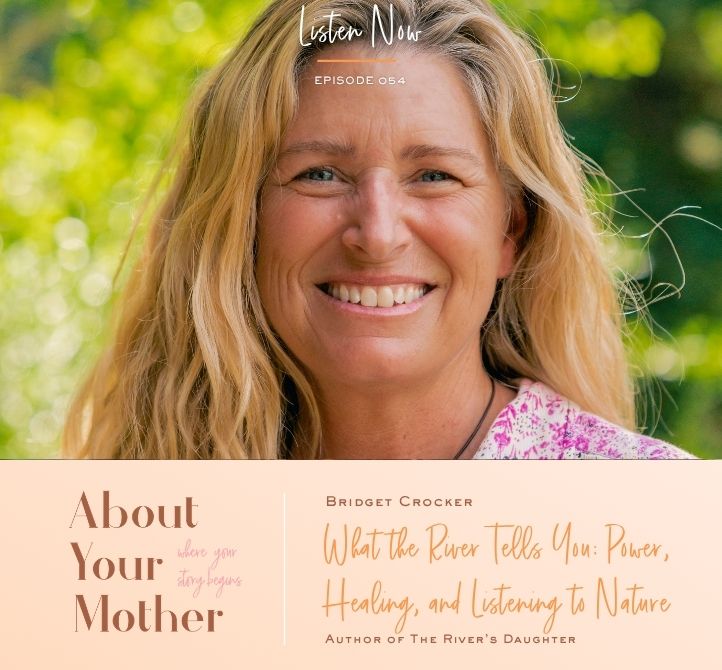
How do you make peace with what your family has given you, both the good and the bad? My guest today is Bridget Crocker, a trailblazer in the outdoor industry and author of The River’s Daughter.
In her incredible memoir, she writes about breaking the cycle of abuse in her family and relying on nature as a guide. Our conversation will inspire you to face your past and look to nature to help you find answers for the future.
This episode is extra special because it was recorded live in front of an audience in partnership with an organization I love, Jackson Hole Writers.
Mothers Are the People Who Affirm Our Lives
Bridget had a complicated relationship to her mother, but she’s had the privilege of having many mother figures and female mentors in her life. These women lifted her up and spoke into her life when she needed it most.
Her experience with mothers, as well as her relationship to Mother Nature, has taught her that mothers are meant to be supportive, life-giving, and life-affirming.
Despite their difficult relationship, Bridget learned a lot from her mother. She passed down her love of literature, art, and adventure. Her mom was from Los Angeles but always dreamed of living in the Tetons, and she made it happen. Today, Bridget considers being raised in Jackson Hole one of her biggest blessings.
Confronting Power and Control in Her Family and the Outdoor Industry
Bridget’s book, The River’s Daughter, chronicles her experience growing up in a troubled family on the Snake River, where unhealthy power dynamics and control were the norm. She also writes about being one of the first female guides in the Jackson Hole outdoor industry, where she encountered a different set of difficult power dynamics.
Another element of the book is the power dynamics in Jackson Hole itself: a resort town where most residents, like her parents, work in the service industry to eke out a living. Lastly, she writes about her time in Africa as a 20-year-old and confronting colonialism for the first time.
At its core, Bridget’s story is about power: who has it, who doesn’t, and how to shift imbalanced power dynamics in the right direction. She and her father bravely worked together to break the cycle of abuse that was present in her family so that it wouldn’t impact her kids. The process required apologies, reparations, and rebuilding trust.
Tuning Into Nature as a Guide
After growing up in Jackson Hole and working as a river guide, Bridget has developed an intimate relationship with the natural world. From a young age, she would sit by the river and simply listen to it, entering into a meditative state that would calm her whole being.
Bridget still listens to the river, and after sitting with it – after a while- she begins to hear messages. After a while, she feels one with nature, becoming the river and the riverbank. Rather than a one-way conversation, an exchange begins. Bridget believes we’re meant to live in connectivity with our environment.
Life on the river gave Bridget the instructions she needed to heal her past wounds and rewrite her story. She learned resilience and the importance of taking action from the lessons the river taught her.
Writing a Memoir Over 22 Years
When Bridget’s father was on his deathbed, he told her that she needed to finish and publish the book she was writing about their family. He didn’t care that he didn’t come off looking very good in the book; he wanted the story of what their family had been through to be released.
The book took 22 years to write, and it was important to Bridget to write it from a place of respect and healing rather than having an ax to grind. She chronicled stories of abuse and the sudden onset of her mother’s personality disorder, but it was written from a place of healing.
Writing her memoir gave Bridget a newfound appreciation for her parents and all that they did to break the cycles of abuse in their families. When they passed the baton to her, she didn’t have far to go to reach the finish line.
Her favorite sentence from the book that sums up her feelings toward her family is this one:
“Over the years, I had spent a lot of time ruminating about what my parents had not given me, overlooking what I had inherited as my birthright: the ability to transform suffering, rise up, and survive.”
Leaning on Community to Write a Memoir
Over the course of writing her book, Bridget changed the structure of it four times. It took on several incarnations and rounds of editing to become what it is today. Throughout the process, she relied on the Jackson Hole Writers organization for feedback and support.
The experience taught Bridget to trust the process, and luckily, it paid off. By the time she took her book to market, it required very little editing.
Bridget ended her book with a long acknowledgment section to thank the people who helped her become who she is today. Specifically, she thanked the women who stepped in as surrogate mothers in her life.
She also wants to say thank you to her younger self who did the heavy lifting of rewriting her family’s legacy.
Resources Mentioned
Connect With the Guest
Bridget’s Book: The River’s Daughter